
The fastest elevator on paper can still underperform if the shaft, power supply, or traffic plan isn’t designed for it. That’s the core challenge of high speed elevator installation India projects: performance depends on coordinated building conditions, elevator specifications, and installation decisions, not just the drive. A mismatch can affect passenger flow, safety, compliance, and long-term operation.
If you’re unsure whether your building can support the required speed, or how to coordinate the shaft, power, controls, and installation plan, it helps to raise those questions early. This 2026 planning guide explains how traffic needs shape elevator selection, which building and technical details to assess, and what safety and compliance requirements to verify for your project. It also covers what to prepare before speaking with an elevator contractor and how to compare suppliers on engineering coordination, installation, and after-installation support. The goal is a system planned around the building and its users, not a speed figure in isolation.
Key Takeaways
- Plan high speed elevator installation India around building height, passenger demand, travel distance, and site conditions, not speed alone.
- Use traffic patterns to inform elevator quantity, capacity, and control strategy; compare traction options against the project’s requirements.
- Assess shaft, structural, and power conditions through a coordinated feasibility review before finalising equipment specifications.
- Prepare a clear project brief and agree on information, responsibilities, testing, and handover steps with the building team and elevator contractor.
- Evaluate suppliers on engineering coordination, equipment scope, compliance evidence, installation, documentation, and ongoing support.
What high-speed elevator installation in India involves
High-speed elevator installation India projects involve more than choosing a lift with a higher rated speed. The building, passenger demand, travel distance, equipment, controls, and installation sequence need to work as one system. Shaft dimensions, structural provisions, electrical supply, door operation, and the planned elevator layout all affect what can be installed and how well it can serve the building.
High-speed elevator installation is the coordinated design, supply, and installation of an elevator system whose speed and capacity are selected to meet a building’s travel and traffic requirements within its site and safety constraints. There’s no single speed figure that defines “high speed” for every project. The term depends on the project context and the technical reference being used, so confirm any category or threshold against the project specifications and applicable requirements. For background on modern elevator systems, readers can review an overview of elevator technology and safety systems.
Speed and capacity both affect service, but they aren’t interchangeable. Rated speed, measured in metres per second, describes the elevator’s specified travel speed. Passenger capacity describes how many people or how much load the car is designed to carry. A higher rated speed alone doesn’t establish how many passengers the system can move in a given period. Stops, door cycles, passenger loading, and control strategy also shape actual service performance.
What determines whether an elevator is considered high speed?
Classification varies with building use, height, travel distance, design brief, and the technical reference used. Don’t assume there’s a universal threshold. Ask the consultant or elevator contractor to state the proposed rated speed and explain the basis for selecting it. Also clarify that rated speed is a specification, while the passenger experience depends on the complete journey, including acceleration, deceleration, stops, and door operation.
Which Indian projects may need high-speed lift planning?
Taller commercial, residential, hospitality, and mixed-use buildings may need this planning, but height alone doesn’t determine the required speed. A residential tower with different occupancy patterns may have different needs from an office or hotel of comparable height. Before specifying speed, capacity, or elevator quantity, work with the design team to assess expected occupancy, peak arrival and departure periods, building use, and travel distance. For residential projects, this guide on how to choose an elevator for an apartment building in India sets out a building-first selection process.
Start with the service requirement, then check it against the building. This helps teams avoid treating speed as an isolated equipment choice and provides a sound basis for the detailed feasibility and system-design review.
How speed, traffic, and elevator technology affect system design
Elevator specifications should reflect how people move through a building, not just how quickly a car can travel. A traffic study helps the design team estimate demand during peak arrival and departure periods, identify which floors generate the most trips, and account for how occupancy changes through the day. The findings inform the number of elevators, car capacity, and dispatch strategy.
For example, an office tower may experience concentrated upward traffic at the start of the workday, while a hotel may have more varied movement between floors. These patterns can lead to different design priorities. Before fixing specifications, validate occupancy assumptions, floor distribution, and expected peak periods with the project architect, consultant, and elevator supplier.
Compare the factors, not just the speed
| Design factor | What it describes | What to assess |
|---|---|---|
| Speed | Rated travel speed, expressed in metres per second | Travel distance and the required journey time, alongside acceleration, deceleration, and stops |
| Capacity | The load or passenger capacity specified for each car | Expected occupancy and whether the car can serve demand without excessive crowding |
| Traffic handling | How the system responds to passenger demand | Peak flows, floor distribution, elevator quantity, and controller dispatch strategy |
| Building constraints | The physical and service conditions at the site | Shaft dimensions, available space, structure, power supply, and intended building use |
How do the drive and control system support high-speed operation?
Geared and gearless traction machines are options to assess against the project’s travel requirements, equipment configuration, building constraints, and operating objectives. Neither is automatically right for every site. The drive and controller need to be specified together: the drive governs motor operation, while the controller coordinates elevator movement and service responses. Door operation and car configuration also matter. If these components are poorly matched, service may be inconsistent even when the rated speed meets the brief.
For high speed elevator installation India, treat the machine, controller, doors, and car as an integrated system. Ask suppliers to explain how the proposed components work together and how the selection reflects the traffic study. 2M LIFTS & ESCALATORS offers ItalianPro geared and gearless machines and Legend Controls elevator control systems; confirm project suitability during engineering review. Its elevator installation and equipment capabilities may be relevant when comparing coordinated supply and installation options.
Can an Indian building support a high-speed elevator? Assess feasibility first
A higher rated speed can’t be selected independently of the shaft, structure, power supply, or passenger demand. A proposed system may require changes to building interfaces or additional coordination. A speed upgrade also won’t necessarily resolve long waits if the underlying issue is elevator quantity or traffic handling.
Establish feasibility through a multidisciplinary review, not a simple yes-or-no sales assessment. The project architect, structural and electrical professionals, elevator consultant, and supplier each need to review the parts of the design they are responsible for. Confirm Indian and project-specific requirements with qualified professionals, including whether standards such as IS 17900 or EN 81 apply and which editions are relevant. Don’t assume a standard or provision applies without verification.
| Potential benefits of faster travel | Planning demands to assess |
|---|---|
| May reduce the travel portion of a journey across a tall building. | Waiting and handling performance also depend on traffic, elevator quantity, capacity, stops, and door cycles. |
| Can support a service strategy designed around longer travel distances. | May require closer coordination of equipment specifications with shaft, structure, power, and building services. |
| Can be assessed as part of a broader passenger-service objective. | Installation access, commissioning, ongoing operation, and maintenance requirements must also be planned. |
Which site conditions should the project team check?
Compare shaft dimensions and alignment, total travel height, pit, overhead, machine space, and structural interfaces with the proposed system drawings. Check the available electrical supply, installation access routes, and coordination with other building services. Record measured site conditions and design assumptions, then have the relevant professionals verify all dimensional, safety, and regulatory requirements for the specific project before approving specifications.
How should teams assess speed against passenger needs?
Compare expected waiting, travel, and passenger-handling needs rather than choosing speed as a prestige feature. The review may show that peak demand, floor distribution, or elevator quantity deserves attention alongside rated speed. Ask the consultant and elevator supplier to explain the implications for design, space, installation coordination, and system operation. Include maintenance and lifecycle requirements, not just initial performance objectives.
For high speed elevator installation India, treat feasibility as a documented engineering decision. The site review should show what the building can accommodate, what changes may be needed, and how the proposed system addresses passenger needs while meeting verified project requirements.
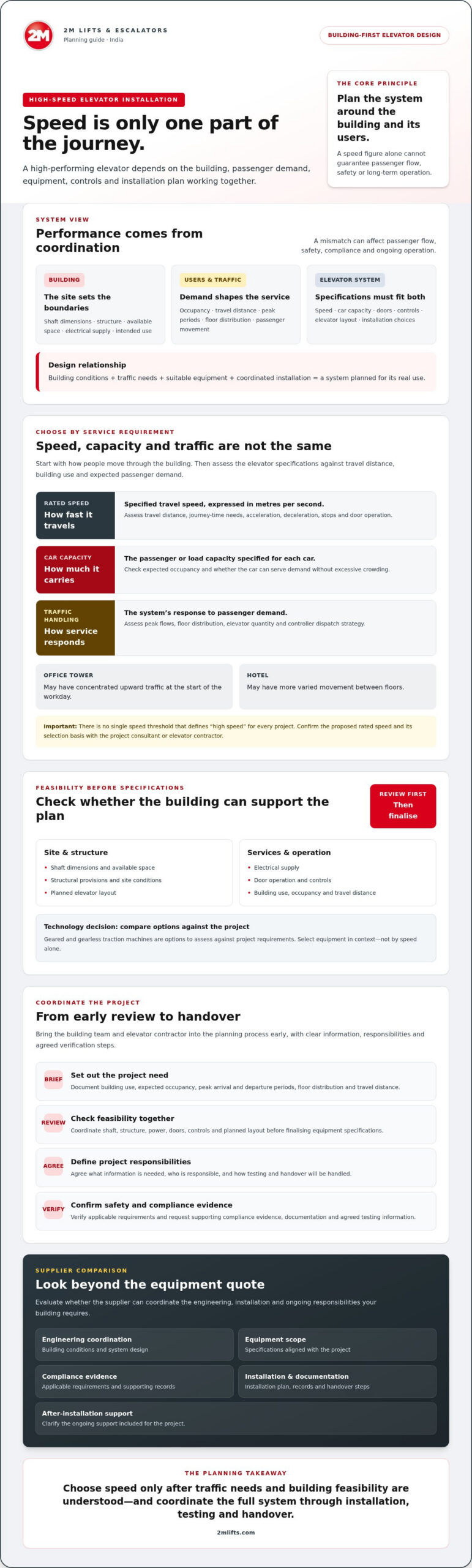
How high-speed elevator installation progresses from survey to handover
A well-managed installation keeps the building team, consultant, and elevator contractor aligned at every stage. The building team provides accurate site and service information; the consultant coordinates design intent and project requirements; and the contractor confirms equipment interfaces, installation needs, and technical submittals. Record decisions and open questions so assumptions don’t become site problems.
What happens before equipment installation begins?
Prepare building plans, the intended speed, traffic assumptions, shaft details, and electrical information before finalising the installation plan. Confirm scope boundaries, design interfaces, site access, and required approvals with the responsible professionals. Maintain a register of unresolved technical questions, including project-specific compliance checks. The schedule depends on scope, site readiness, approvals, and equipment availability, so confirm dependencies instead of relying on a generic timeline.
- Define the brief. The owner and design team document building use, passenger needs, performance objectives, and known site constraints.
- Survey the site. The contractor reviews available site information and checks relevant shaft, structural, electrical, and access conditions with the project team.
- Coordinate and approve the design. The consultant and contractor align equipment specifications, drawings, interfaces, scope, and project-specific requirements for review by the responsible professionals.
- Install and track interfaces. The contractor carries out the agreed installation while the building team coordinates access and site readiness. Record and resolve changes or clashes through the project’s agreed process.
- Test, document, and hand over. The relevant parties review test results against agreed acceptance criteria, close outstanding items, and transfer operating and maintenance information.
What should testing and handover cover?
Agree on the project-specific test scope and acceptance criteria before commissioning. Testing should verify relevant functions and safety-related performance against approved specifications, with results recorded for review. A universal checklist can’t replace applicable project requirements. At handover, provide the agreed technical and operating documents, orient the designated building representatives, and clarify who handles maintenance, routine reporting, and fault escalation.
Commissioning confirms that the installed elevator system has been tested against the approved project specifications and that results have been documented for handover. For high speed elevator installation India, this check connects design intent with actual site conditions. Confirm that the appropriate professionals have reviewed any required approvals and compliance evidence.
Need support coordinating equipment, installation, and maintenance requirements? Discuss your elevator project with 2M LIFTS & ESCALATORS.
Choosing a high-speed elevator installation partner in India
The right supplier should explain how engineering decisions connect to equipment, site installation, testing, and ongoing support. For high speed elevator installation India projects, assess documented capability and clear project responsibilities, not a headline speed or broad performance promise. Ask for relevant examples and technical records showing how the supplier handled comparable building conditions and project requirements.
What questions should you ask an elevator contractor?
- Engineering: Who coordinates equipment selection with shaft interfaces, structural provisions, electrical requirements, and other building services? How are design changes and unresolved issues recorded?
- Equipment scope: Which machines, controls, doors, and other system components are included? What is excluded, and who resolves interface gaps?
- Installation: What site access and readiness conditions must the building team provide? Who is responsible for coordinating installation activities?
- Testing and compliance: Which project-specific requirements and acceptance criteria will guide testing? What test records and compliance documents will be handed over? Have qualified professionals confirmed the applicable standards and editions?
- Support: What maintenance scope is proposed, who receives service requests, and how are faults escalated? Verify service coverage and response arrangements for your location rather than assuming they’re included.
Check experience carefully. Ask for references from projects with relevant travel height, building use, traffic demands, or equipment scope. Where available, review project documentation and speak with the client about coordination, handover, and support. Verify any claimed certification or approval directly, and assess each reference against your requirements. This gives you a stronger basis for comparison than an unsupported promise of speed or performance.
Use this checklist to compare proposals on accountability as well as equipment. A supplier who can explain interfaces, exclusions, testing evidence, and maintenance responsibilities clearly gives the project team a firmer basis for decision-making.
How can 2M support a high-speed elevator project?
2M LIFTS & ESCALATORS is a Cochin-based elevator and escalator company with over 22 years of operating history and projects across India. Its stated capabilities include turnkey supply, custom engineering, installation, maintenance, and emergency repair. The company supports elevator speed requirements up to 2.5 m/s, but that figure isn’t a recommendation for every building. Confirm the proposed speed, configuration, installation scope, and project suitability directly with the engineering team.
Assess those capabilities against your documented brief, site conditions, and support needs. Discuss your elevator project with 2M and clarify the technical information needed to evaluate its fit.
Plan the system around the building and its people
A successful high-speed elevator project starts with coordinated decisions, not a speed figure alone. Match rated speed, capacity, and control strategy to passenger traffic, then confirm that the shaft, structure, power supply, and installation conditions can support the proposed system. Before work begins, align the building team, consultant, and elevator contractor on scope, project-specific requirements, testing, and handover records.
Supplier selection matters just as much. Look for clear engineering coordination, defined equipment and installation responsibilities, documented testing, and a practical maintenance plan. Verify applicable compliance requirements and service availability for your project rather than relying on broad assurances.
For high speed elevator installation India projects, 2M LIFTS & ESCALATORS brings over 22 years of operating history and turnkey elevator supply, engineering, installation, and maintenance capabilities. The company serves projects across India, though project-specific service availability should be confirmed. Share your building plans, traffic assumptions, and site details to start a focused discussion.
Discuss your high-speed elevator project with 2M. With the right information and engineering coordination in place, you can move forward with a plan built around your building’s requirements.
Frequently Asked Questions
What is considered a high-speed elevator in India?
There isn’t one speed threshold that defines a high-speed elevator for every Indian project. Classification can depend on the building context and the technical reference used. Speed is the elevator’s rated travel rate, usually expressed in metres per second; it’s separate from passenger capacity and doesn’t, by itself, describe waiting time or overall service. Ask the project consultant or supplier to state the proposed speed and the basis for selecting it.
How fast can an elevator travel in a high-rise building?
The suitable speed depends on travel height, passenger demand, system design, and building conditions. 2M Lifts & Escalators states that it supports elevator speed requirements up to 2.5 m/s, but that figure isn’t suitable for every building or project. Confirm the required speed, system configuration, and available installation scope with the supplier and project professionals. Assess expected waiting and journey times as well as rated speed.
Can an existing building support a high-speed elevator installation?
Possibly, but a site-specific engineering review must establish feasibility before equipment is selected. The team should assess the shaft, structure, pit, overhead, machine space, electrical supply, installation access, and passenger traffic. Existing dimensions or services may not align with the proposed system and could require design changes. For high speed elevator installation India, have qualified project professionals and the elevator supplier review the building information together.
What building details are needed before planning a high-speed elevator?
Prepare building plans, shaft dimensions, travel height, pit and overhead details, structural information, machine-space provisions, and electrical supply data. Include building use, occupancy assumptions, floor distribution, expected peak traffic, and installation access routes. Note other building-service interfaces and known site constraints. The design team and elevator supplier can use these details to assess feasibility, identify missing information, and confirm which project-specific approvals or compliance checks need verification.
How does passenger traffic affect elevator speed and capacity?
Passenger traffic helps determine elevator quantity, car capacity, and dispatch strategy, while rated speed describes how quickly a car travels. A busy arrival period may create waiting even if the elevator has a high rated speed. Floor distribution, occupancy, stops, and door cycles also affect service. A traffic study, reviewed with the architect, consultant, and elevator supplier, helps balance waiting, travel, and handling needs rather than treating speed as the only performance measure.
Which standards apply to elevator installation in India?
Applicable requirements depend on the project and its location. IS 17900 and EN 81 may be relevant references, but don’t assume a particular standard, edition, or provision applies universally. Ask qualified project professionals to confirm current requirements, including any relevant state-level rules, and request documentation showing how the proposed system addresses them. Verify claimed certifications, approvals, and compliance evidence for the specific equipment and installation before relying on them.
How long does high-speed elevator installation take?
There’s no reliable single timeline for every project. The schedule depends on scope, site readiness, approvals, design coordination, and equipment availability, as well as installation and testing requirements. Ask the contractor for a project-specific programme that identifies dependencies, building-team responsibilities, review points, and handover activities. Confirm how changes or delays will be communicated. A schedule based on verified site conditions is more useful than a generic duration.